
Xolunex
Xolunex® – Honest. Transparent. Reliable.
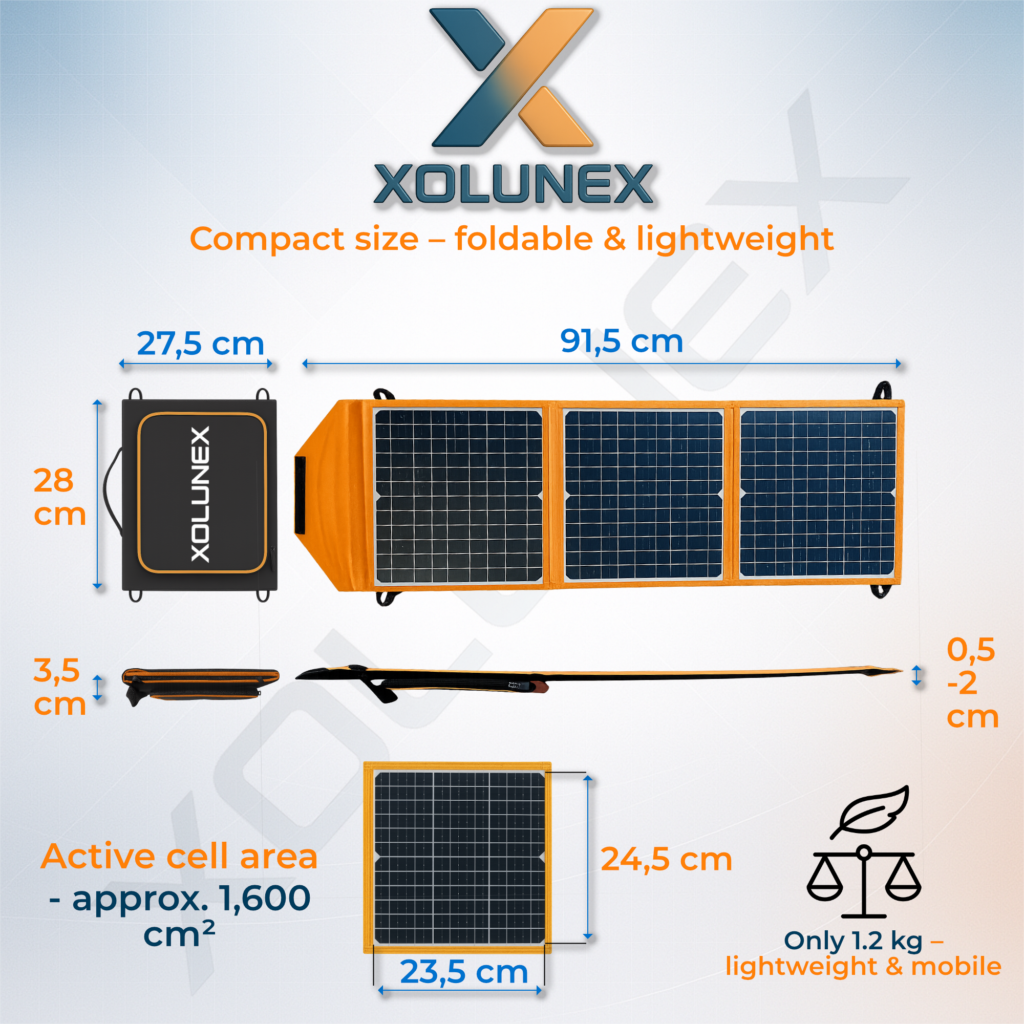
- Approx. 1,600 cm² active cell area – no casing tricks, real measurement
- Premium monocrystalline cells: efficiency up to 26% in the lab / 20–23% effective
- Real-world output of 26 to 34 W – explained openly and transparently
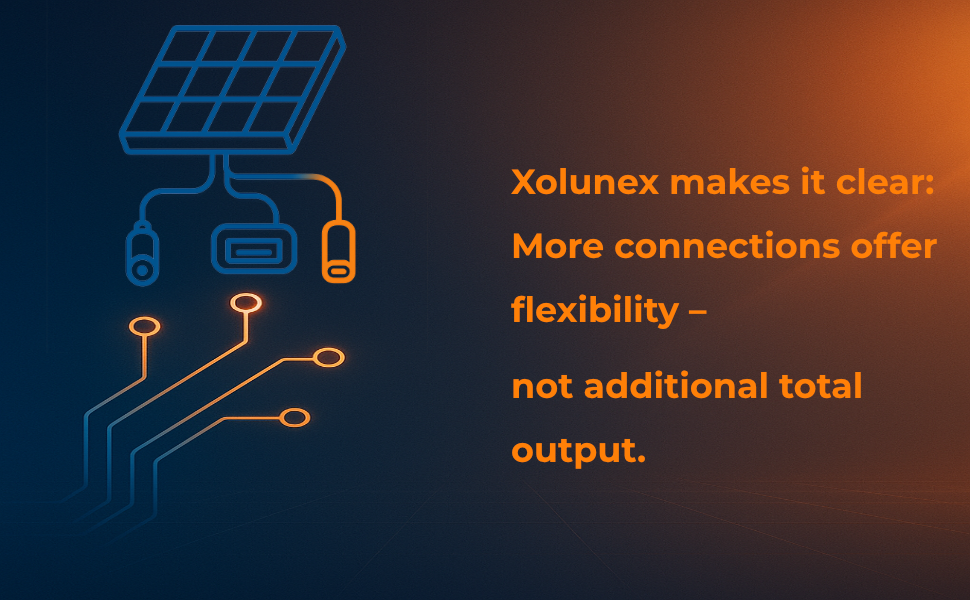
- 2× USB (incl. 1× fast-charging port) + 1× DC output
- Integrated protection circuit – overcurrent, overvoltage, short-circuit
- Practical IP54 protection – splash-proof, outdoor-suitable, with
- Robust 900D outdoor material + transparent protective cover – durable
- USB tester included – check & optimize performance yourself
Xolunex – honest, transparent, and reliable.
Many manufacturers promise a lot — but outdoors, in real life, disappointment is often what remains.
Lab figures, polished watt numbers, supposed “IP67” ratings that don’t hold up in practice — anyone who has bought such a panel knows how big the gap between advertising and reality can be.
Xolunex takes a different approach.
We don’t give you fantasy numbers, but real ones: from cell area to efficiency to real-world output. We explain transparently how the values are determined — and we even include a tool (USB tester) so you can measure performance yourself at any time.
Our panels are designed to not only work today, but to deliver power reliably even years from now. That’s why we rely on:
- high-quality monocrystalline premium cells instead of cheap goods,
- a 900D outdoor fabric that withstands wind and weather,
- and an electronics unit with protection chips that safeguards your devices.
The result is a panel that doesn’t just “sort of work,” but gives you exactly the safety, transparency, and performance you need outdoors.
👉 Others conceal — we explain.
With Xolunex, you’re not buying guesswork, but an honest premium solar panel built on quality, transparency, and durability.
📊 Chapter 1 – Active Cell Area, Cell Types & Efficiency
Why some “30-watt” panels barely deliver 15 watts in real life — and how you can instantly tell whether someone is trying to rip you off:
The output of a solar panel is fundamentally based on two factors:
- active cell area (how much area actually generates electricity)
- efficiency (how much of the light is converted into electrical energy)
The larger the active area and the higher the efficiency, the more power is physically possible.
Xolunex uses approx. 1630 cm² of active monocrystalline premium cells — this is the real working area, not just the external size of the panel.
Cell types compared:
- Monocrystalline – 18–23%, highest efficiency, best quality
- Polycrystalline – 13–18%, cheaper, less efficient
- Thin-film – 7–12%, requires large area, lowest durability, lowest efficiency
For mobile solar panels, monocrystalline is the technically most sensible choice.
1.1 Key basics explained briefly
To assess specifications correctly, it helps to distinguish between different area and efficiency terms:
- Cell efficiency = efficiency of individual test cells under ideal lab conditions (for high-quality mono cells approx. 26%)
- Module efficiency = efficiency of the complete panel incl. coating, busbars & transitions (realistically 20–23% for high-quality mono cells)
- Active cell area = the area where solar cells are actually installed and where light is converted into electrical energy
- Gross area = the outer total size of the panel incl. textile, seams, gaps and non-populated sections (irrelevant for output)
Xolunex also states the active cell area.
1.2 What others do wrong or deliberately hide
Many manufacturers confuse customers by:
- stating the casing area instead of the active cell area
- using cell efficiency as a marketing number
- lacking transparency about actual module efficiency
- providing no data about the truly usable area
- watt figures without physical basis
- no explanation of how output is generated at all
Result:
The customer does not know what output is realistically achievable — and has no way to verify these values.
1.3 What Xolunex does better
Xolunex consistently focuses on honesty, transparency & traceability:
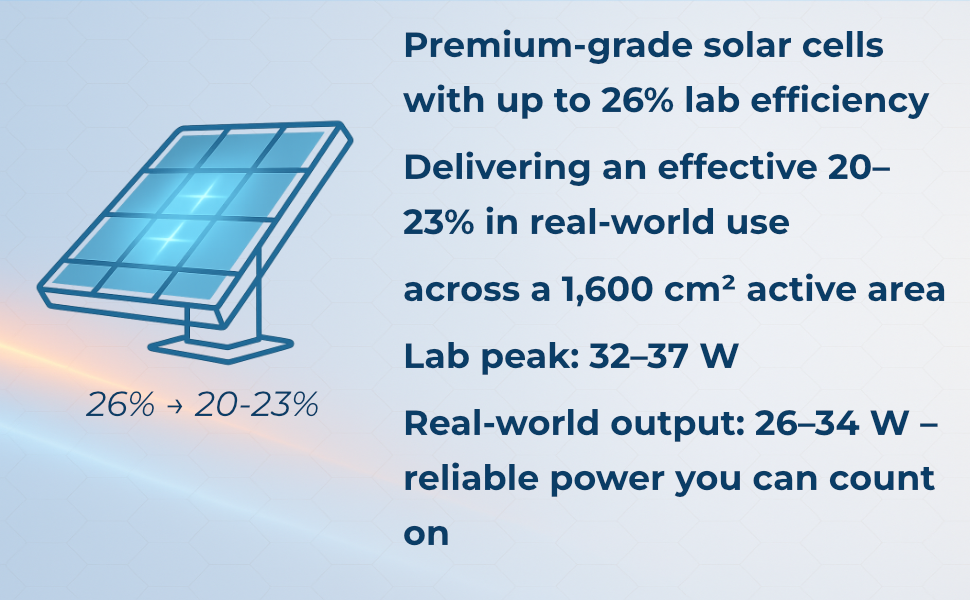
- approx. 1600 cm² active cell area – measured cleanly and clearly defined
- premium mono cells with real module efficiency of approx. 20–23%
- no polished lab figures or fantasy claims
- clear formula:
- Active cell area × Module efficiency = physically possible output
- thanks to the USB tester, every customer can verify real output themselves
- all dimensions & values stated completely so comparisons are possible
We communicate openly how output is generated and why our specifications are realistic, practical, and verifiable at any time.
Conclusion:
Only a large active cell area + a real module efficiency of 20–23% produce physically real output. Everything else is marketing — with the USB tester, you can see the difference immediately yourself.
1.4 Link to the technical detail page
The technical fundamentals from Chapter 1 and Chapter 2 are closely connected. Therefore, the following link leads on both pages to the same detail page, where all information is explained compactly and completely.
🔗 How solar cells really work – efficiency and differences explained
🟠 Chapter 2 – Real Power Output of a Solar Panel
Why your solar panel may suddenly appear “weak” in midsummer even though everything is working normally — and why you often get more power in spring than in July:
A solar panel does not produce a constant power output.
The real power delivered depends on several external factors:
- Cell temperature
- Angle of solar incidence
- Weather conditions & light spectrum
- Shading & surface cleanliness
- Orientation and time of day
Theoretical Power Under Ideal Conditions (STC)
Under Standard Test Conditions (STC)
(25 °C cell temperature, 1000 W/m² irradiance, perpendicular light incidence)
the theoretical module power can be calculated directly:
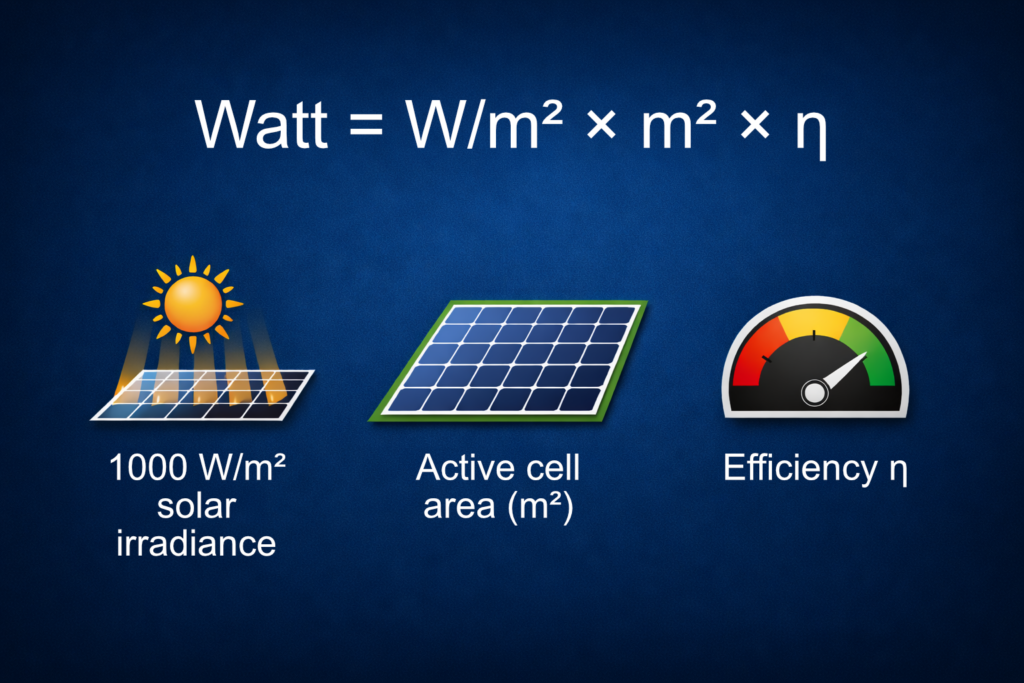
Power (W) = Irradiance (W/m²) × Active cell area (m²) × Efficiency (η)
Example Calculation for This Solar Panel
- Irradiance: 1000 W/m²
- Active cell area: approx. 0.163 m²
- Cell efficiency: approx. 20–23 %
→ 1000 × 0.163 × 0.20–0.23 ≈ 32–37 W (theoretical, STC)
These values represent the maximum achievable laboratory output of the installed solar cells.
Real Outdoor Power Output – Properly Classified
In real-world use, conditions rarely match STC exactly.
Higher cell temperatures (typical in midsummer), fluctuating irradiance and non-ideal angles of incidence lead to natural and unavoidable losses.
Under good to very good real outdoor conditions, the panel typically delivers approximately 26–34 W.
The deviation from laboratory values results from typical total losses of around 10–20 %, caused by temperature effects, angle of incidence, and electrical conversion losses.
This power output is fully explainable by physics and can be directly measured and verified using the included USB tester.
2.1 The most important influencing factors – explained briefly
🌡 Temperature
Solar cells lose efficiency as they heat up:
- approx. 30 °C ambient temperature → cells ~55–60 °C → –6 % power
- strong summer heat → cells >60 °C → –10 % power or more
The hotter the cell, the lower the efficiency.
That’s why panels often achieve higher wattage in spring than in midsummer.
🔆 Angle of irradiation

Optimal is a 90° angle directly facing the sun (perpendicular light incidence).
Even small deviations significantly reduce output:
- 30° deviation → ~87 % remaining power
- 45° → ~71 %
- 60° → ~50 %
- 75° → ~26 %
That’s why foldable panels are ideal for precise alignment.
🌤 Weather & light spectrum
| Condition | Relative output |
|---|---|
| Clear sky | 100 % |
| Light cloud cover | 60–80 % |
| Heavy cloud cover | 20–40 % |
Less direct radiation = less energy.
The light spectrum also shifts, further affecting yield.
🌲 Shading & dirt
Even very small shadows can have massive effects:
- 10 % partial shading → 30–50 % power loss
Dirt, dust, leaves or even a thin branch are immediately measurable.
Reason: internal string wiring reacts very sensitively to shading of individual cells.
🧭 Orientation
- Morning & evening: low sun angle → lower output
- Midday sun delivers the highest values
- Optimal: open area, direct irradiation, no shade
2.2 What other manufacturers do wrong or deliberately omit
Many panels advertise 30–40 W output, but fail to mention:
- that these values are only achievable under STC laboratory conditions
- that high cell temperatures significantly reduce power
- that angle, clouds and shading cause immediate, measurable drops
- that partial shading can shut down entire cell strings
- that their electronics become unstable under changing light
- that without a measuring device, no real control is possible
Result:
Customers believe their panel is “weak”, although the conditions are the real cause – and because manufacturers use numbers that have nothing to do with real-world usage.
2.3 What Xolunex does better
Xolunex stands for honest and realistic performance representation:
- clear separation between laboratory values and typical real-world values
- transparent explanation of all influencing factors
- realistic output range: 26–34 W under good conditions
- USB tester included – real output can be verified at any time
- electronics stabilize voltage even under fluctuating light
- real, practical examples instead of polished marketing figures
Possible real-world values:
- Summer, 30 °C ambient → approx. 23–25 W
- Spring, 15 °C ambient → approx. 27–34 W
- Light cloud cover → approx. 18–19 W
This gives you a panel that is realistically rated – and convincing under real conditions, without false promises.
Conclusion
26–34 W under good real-world conditions are absolutely realistic for this panel and can be verified at any time – instead of inflated laboratory values you will never reach in practice.
2.4 Link to the technical detail page
The technical fundamentals from Chapter 1 and Chapter 2 are closely connected.
Therefore, the following link leads on both pages to the same detail page, where all information is explained compactly and completely.
🔗 How solar cells really work – efficiency and differences explained
🟣 Chapter 3 – USB Ports, Current, Voltage & Load Distribution
“Charge 3 devices at the same time quickly!” – the biggest myth in the mobile solar market and why you simply can’t cheat physics.
A solar panel does not deliver a fixed output power. Three factors determine how fast a device actually charges:
- How much power the panel can generate
- How much power the individual port can provide
- How much power the connected device can actually accept
Many manufacturers hide this relationship and create false expectations.
Xolunex explains openly how power draw, fast charging and device limits really work – so there are no surprises.
3.1 Important Basics – short & easy to understand
🔌 Voltage (V)
USB operates at 5 V, 9 V or 12 V, depending on the protocol.
The panel supports several common fast-charging protocols (Apple 2.4A, Samsung D+/D-, Divider 1/2), which are provided via fixed signaling on the data lines.
⚡ Current (A)
The panel does not “push” current into the device —
the device only draws what it can technically support.
Examples:
- Many devices: 8–12 W
- Fast-charge capable devices: up to 18 W
- Some power banks: 12–18 W
🔋 Power (W)
Formula:
W = V × A
Examples:
- 5 V × 3 A = 15 W
- 9 V × 2 A = 18 W
🔄 Behavior with Multiple Devices
When several devices are connected:
- the total output of the panel is shared
- fast charging may drop depending on the device if sunlight is insufficient
- each port only delivers what the connected device supports
There is no prioritization, only a simple distribution of the available power.
📉 Device-Specific Limits & Charging Behavior
Important:
A device always charges only as fast as it is technically designed to and as permitted by its currently active charging mode.
Depending on the device state — such as power-saving mode, night charging mode, intensive charging protection or a high battery level (e.g. from 90–95 %) — the charging power may be intentionally reduced, even though the solar panel could technically provide more.
Example:
A smartphone that supports a maximum of 10 W will charge at 10 W on both the normal USB port and the fast-charge port.
The solar panel cannot force higher values.
⚡Fast Charging with Solar Power – Why It’s Not Always Activated
In practice, a smartphone may not switch into fast-charging mode even when sufficient power is available — even under optimal sunlight.
This is not due to the maximum output of the solar panel, but to the charging behavior of modern devices:
- smartphones react very sensitively to even minor voltage fluctuations
- minimal changes caused by:
- re-aligning the panel
- changing sunlight intensity
- thermal influences
can cause fast-charging mode to not activate at all or to deactivate immediately
At a wall socket, these conditions are constant — which is why fast charging works more reliably there.
🔋Recommendation for Stable Charging
For more stable charging performance, we recommend first charging a suitable power bank via the solar panel and then charging your smartphone from the power bank.
Power banks can:
- compensate voltage fluctuations more effectively
- buffer energy
- provide a constant power source to the device
This makes fast-charging — depending on the device — significantly more reliable.
3.2 What Other Manufacturers Get Wrong or Don’t Mention
Many panels advertise USB features that technically make no sense.
Multiple USB Ports (3–5 ports) with only 30 W total output
A standard USB port can deliver up to 15 W, a fast-charge port up to 18 W. Multiple ports may sound appealing, but are physically meaningless:
👉 A 30 W panel cannot output 50–70 W across multiple ports.
No Explanation of Device Limitations
Customers are often led to believe: “Fast charging = always 18 W.” In reality, the device itself decides.
No Transparency About Power Distribution
Many panels:
- drop out of fast charging immediately
- become unstable in cloudy conditions
- distribute power arbitrarily
- create expectations that are physically impossible
Marketing Instead of Physics
Advertising claims such as:
“Charge 3 devices fast at the same time!”
→ In reality, the same 30 W total output is simply divided
→ and the fastest device suddenly charges slower than before
3.3 What Xolunex Does Better
Xolunex focuses on honesty, stability and sensibly designed ports.
Three Ports That Actually Make Sense
- USB 1: up to approx. 15 W (5 V / 3 A)
- USB 2 (Fast Charge): up to approx. 18 W (5 V / 3 A; 9 V / 2 A; 12 V / 1.5 A)
- DC: up to approx. 30 W (18 V / 1.66 A)
→ No marketing overkill, but a technically sound configuration.
Clearly Defined Power Logic
- panel output is simply distributed
- fast-charge profiles are available, but static
- no artificial performance promises
Transparency Toward Customers
We openly explain:
- why not every device charges fast
- why more ports do not mean more power
- how devices limit their own charging power
- how real values can be verified using the USB tester
USB Tester = 100 % Control
Every customer can measure and verify for themselves:
- actual wattage
- voltage & current
- influence of clouds, angle and temperature
- device limitations
- optimal panel alignment
No guessing — no false expectations. Only verifiable values.
Conclusion:
Three sensibly dimensioned ports plus honest physics outperform five “fast-charge” ports that together cannot even reach 30 W. You charge exactly as fast as your device truly allows — and thanks to the tester, you know exactly why.
3.4 Link to the Technical Detail Page
The technical basics from Chapter 1 and Chapter 2 are closely related.
Therefore, the following link leads to the same detailed page on both sections, where all information is explained clearly and compactly.
Chapter 4 – Protection Circuits & Electronic Control Unit
What happens when the sun suddenly breaks through or a cloud passes by — and why cheap panels can put your devices at risk:
A solar panel generates energy that constantly fluctuates depending on sunlight, angle and shading. To ensure USB devices still charge reliably, the panel is equipped with an integrated electronic control unit that provides the most important safety functions:
- Overvoltage Protection (OVP)
- Overcurrent Protection (OCP)
- Short-Circuit Protection (SCP)
These functions ensure that the output voltage does not rise uncontrollably and that connected devices remain protected — even when sunlight conditions change rapidly.
Important to know:
- Modern smartphones, tablets and power banks have their own internal protection mechanisms, which are sufficient in most situations.
- The panel electronics therefore act as an additional layer of protection, not the only one.
- For older or simpler devices (e.g. outdoor lamps, basic electronics), the panel’s internal protection circuitry can be decisive.
- Note on the DC output:
The 18 V DC port — as is common with mobile solar panels — is directly output and not additionally internally regulated.
In this case, protection is usually handled by the connected device itself, as power stations, laptop electronics and other DC consumers already include their own protection and regulation mechanisms.
4.1 The Most Important Protection Functions – Explained Briefly
🔌 1. Overvoltage Protection (OVP)
Limits the output voltage if the solar cells generate more voltage than permitted due to sudden strong sunlight.
⚡ 2. Overcurrent Protection (OCP)
Reduces the current flow if a connected device attempts to draw more current than is safely possible.
🔧3. Short-Circuit Protection (SCP)
Detects defective cables, incorrect connections or short circuits and disconnects the output within fractions of a second.
🌤 Basic Stabilization Under Changing Light Conditions
The electronics stabilize the output voltage within their technical limits.
With very strong fluctuations (e.g. dark clouds), fast charging may drop or be interrupted — this is completely normal for mobile solar panels.
🔌 Fast-Charging Profiles on the Fast Port
The orange USB port supports several static fast-charging protocols:
- Apple 2.4A
- Samsung D+/D- 1.2
- Divider 1 / Divider 2
These profiles enable fast charging without dynamic communication — simply through defined signal levels on the data lines.
4.2 What Other Manufacturers Get Wrong or Don’t Mention
As already explained in Chapter 3, many USB ports on small panels (e.g. 30 W) are technically unnecessary.
From an electronics perspective, this inevitably leads to an additional problem:
More Ports = More Electronics = Higher Costs or Lower Quality
Each USB port requires:
- current limiting
- voltage limiting
- short-circuit monitoring
- D+/D- signaling
With very inexpensive panels, this usually means:
- either the price would have to increase to secure everything properly
- or component quality is reduced
What This Often Looks Like in Practice:
- instabile Spannungen
- Ladeabbrüche bei Wolken
- unzuverlässige Schnellladung
- Ports liefern deutlich weniger als angegeben
What Is Also Rarely Mentioned
- Some very cheap panels have no real regulation at all — the cells are effectively connected almost directly to the USB port.
- Modern devices have their own protection mechanisms — which is why poor panel output often only becomes noticeable later.
- Older or simpler devices do not have this protection and therefore depend on properly functioning panel electronics.
In Short:
👉 What matters is not the number of ports, but the quality of the electronics behind them.
4.3 What Xolunex Does Better
Xolunex uses clear, technically sensible electronics that focus on what matters most — reliability and stability:
- solid, regulated USB output
- active protection against overcurrent, overvoltage and short circuits
- integrated fast-charging profiles for many common devices
- stable 18 V output on the DC port
- sensibly dimensioned number of ports (2× USB + DC)
- clear and realistic performance specifications
Verified with the USB Tester
In combination with the USB tester, every user can verify the output values themselves:
- wattage
- voltage & current
- behavior under cloudy conditions
- limits of their own device
This keeps the charging process transparent and fully understandable.
Conclusion:

Solid OVP, OCP and SCP combined with stable voltage — even under fluctuating light — keep your devices safe, without relying on excessive ports or low-quality electronics.
4.4 Link to the Technical Detail Page
The technical basics from Chapter 1 and Chapter 2 are closely connected.
Therefore, the following link leads to the same detailed page from both sections, where all information is explained clearly and compactly.
Chapter 5 – IP Protection & 900D Outdoor Material
IP67 across the entire panel? Sounds great — but why this is physically hardly possible with foldable panels and what really matters instead:
For a mobile, foldable solar panel, two factors are decisive for outdoor use:
- The IP protection of the electronic unit
- How robust the panel’s outer material is designed
Because foldable panels always include textile areas, seams and moving segments, high protection classes such as IP65 / IP67 for the entire product are technically hardly achievable without fully encapsulating the panel.
That’s why a clear and honest specification is essential:
- The electronic unit is IP54 protected
(dust-protected & splash-proof) - The panel uses 900D outdoor fabric, designed for load, weather and transport
This means:
Outdoor-capable, robust and splash-proof — without false promises.
5.1 The Most Important Basics – Explained Clearly
🔰 900D Outdoor Fabric
900D is a very robust textile fabric
(“Denier” = thread thickness).
It is characterized by:
- high abrasion resistance
- robust fiber structure
- high tear resistance
- good UV resistance
- low water absorption
- long-lasting surface durability
Typical applications include:
- outdoor backpacks
- tool bags
- tent accessories
- abrasion-resistant protective covers
This makes 900D ideal for camping, travel and all types of outdoor use.
🌧 IP54 – What Does That Mean?
“IP” stands for Ingress Protection — protection against the ingress of dust and water.
An IP code consists of two digits:
- first digit → protection against dust
- second digit → protection against water
IP54 means:
- 5 → Dust protection: Dust can enter, but not in harmful quantities
- 4 → Splash protection: Protection against rain and splashing water from all directions
This means the panel is:
- safe to use in rain
- usable on damp surfaces
- protected during transport
- robust against dirt, sand and outdoor environments
5.2 What Other Manufacturers Get Wrong or Don’t Mention
Many providers communicate protection ratings and materials only superficially or misleadingly:
- IP65 / IP67 for the entire panel, although these values usually apply only to the solar cells
- cheaper materials such as 300D or 420D — often without clear disclosure
- unprotected electronic units or missing information about which areas are actually protected
As a result, customers can hardly assess how weather-resistant a panel truly is.
5.3 What Xolunex Does Better
Xolunex deliberately relies on clear and verifiable specifications:
- IP54-protected electronic unit, housed in a separate compartment
- 900D outdoor fabric for durable, robust use
- honest communication, without exaggerated IP ratings
- clean separation between material specifications and protection class
We only state what is technically correct — no lab-only claims, no “full IP protection” statements that are unrealistic for foldable panels.
The combination of IP54 + 900D ensures long-lasting, stable outdoor suitability.
Conclusion
IP54 protection at the electronics plus extremely robust 900D fabric = truly outdoor-ready — without unrealistic IP67 promises that a foldable panel simply cannot fulfill.
5.4 Link to the Technical Detail Page
Chapter 6 – USB Tester: Real Measurement & Practical Use
Without a measuring device, every solar panel is a guessing game. With the included USB tester, you know within 5 seconds what your panel is actually delivering — and whether it is perfectly aligned:
The USB tester is not an accessory — it is a tool that gives you full control over your solar panel.
It displays the real values that occur during charging:
- Watt (power output)
- Volt (voltage)
- Ampere (current)
- mAh / Wh (energy over time)
- Chip temperature
- Resistance (Ω)
- Time measurement (up to 99 h)
- 9 memory groups
This allows you to optimally align the panel, evaluate performance and clearly understand charging situations — without guessing, without speculation.
6.1 Why the USB Tester Is Useful
🔍 1. Check Performance in Real Time
The tester shows exactly what the panel is delivering right now.
This lets you immediately see:
- optimal sunlight conditions
- performance losses due to heat
- effects of angle, clouds and shading
- whether fast charging is active
- how much current the device is actually drawing
Typical measured values:
- approx. 26–34 W under good conditions
- approx. 18–23 W with light cloud cover
- approx. 12–15 W at high cell temperatures
🧭 2. Align the Panel Optimally in Seconds
Set up the panel → observe the watt value → find the best position.
Time required: just a few seconds.
Especially useful for:
- camping
- balcony use
- garden
- outdoor activities
- traveling in a car or van
📊 3. Understand the Behavior of the Connected Device
The tester transparently shows:
- whether fast charging is active
- how stable voltage and current remain
- whether the device is limiting power itself
- how much power the device actually accepts
Example:
Many smartphones charge at 8–12 W, even if the port could theoretically provide 18 W.
🔌 4. Efficient, Flexible & Independent of the Panel
An external USB tester offers technical advantages over integrated displays:
- no continuous load on the panel
- no additional functions that would permanently power internal electronics
- measurement only when needed → full power available for the connected device afterward
- no energy loss from a constantly active display
In addition, it is universally usable:
- with power banks
- with USB chargers
- in the car
- with other solar panels
- for testing different adapters or USB devices
This makes an external tester not only more precise, but also the more efficient and flexible solution.
6.2 Summary
The USB tester enables:
- true performance measurement
- fast and accurate alignment
- transparency regarding device behavior
- stable charging through value monitoring
- efficient charging without integrated display losses
- versatile use, independent of the panel
In short:
It makes visible what would otherwise remain hidden — precise and available at any time.
Conclusion:
The included USB tester transforms your solar panel from belief into knowledge.
You see live what actually arrives, align the panel optimally within seconds, and never again have discussions about “perceived” performance.
Downloads
At the following link you will find all official documentation and certificates for this product: